
Scottsdale + online throughout Arizona
Discernment Counseling in Scottsdale
When the future of your relationship feels uncertain, you do not have to force an answer before you are ready. Make room for an honest next step.
Request a Free 20-Minute Consultation
A different place to begin
Clarity before a bigger decision.
Sometimes the question is not how to improve the relationship. It is whether there is enough willingness, safety, and hope to try. Discernment counseling is a brief, structured process for this exact moment.
It gives each partner room to speak honestly, understand the pattern that brought you here, and consider what real repair would ask of both of you. No one is pushed toward staying or leaving.
Explore discernment counselingWhen a relationship reaches a crossroads
You may be carrying different answers to the same question.
One partner may be quietly imagining life apart while the other is trying to hold on to the relationship. You may still care deeply for each other and feel exhausted by years of conflict, distance, or the sense that every important conversation turns into the same painful loop. The uncertainty can become its own source of pressure: one person wants a decision now, while the other is not ready to promise a repair they cannot yet believe in.
That is not a small disagreement. It is a different starting point from couples therapy. When a couple begins repair-focused work before both people are ready, the person who is unsure can feel cornered and the person who wants to stay can feel even more afraid. Discernment counseling slows the pressure down. It makes space to understand what has happened before asking either person to decide the rest of their life in one conversation.
What the process makes room for
Less pressure. More truth.
Name the crossroads
Talk about what has become painful, distant, or uncertain without turning the session into another argument or a case against each other.
Understand the pattern
Look at the injuries, protective habits, and choices that shaped the relationship so neither person has to carry the full story alone.
Choose a next step
Move toward a clearer direction: a defined effort to repair, more individual reflection, or a thoughtful separation.
Specialized training
Guidance for the question beneath the conflict.
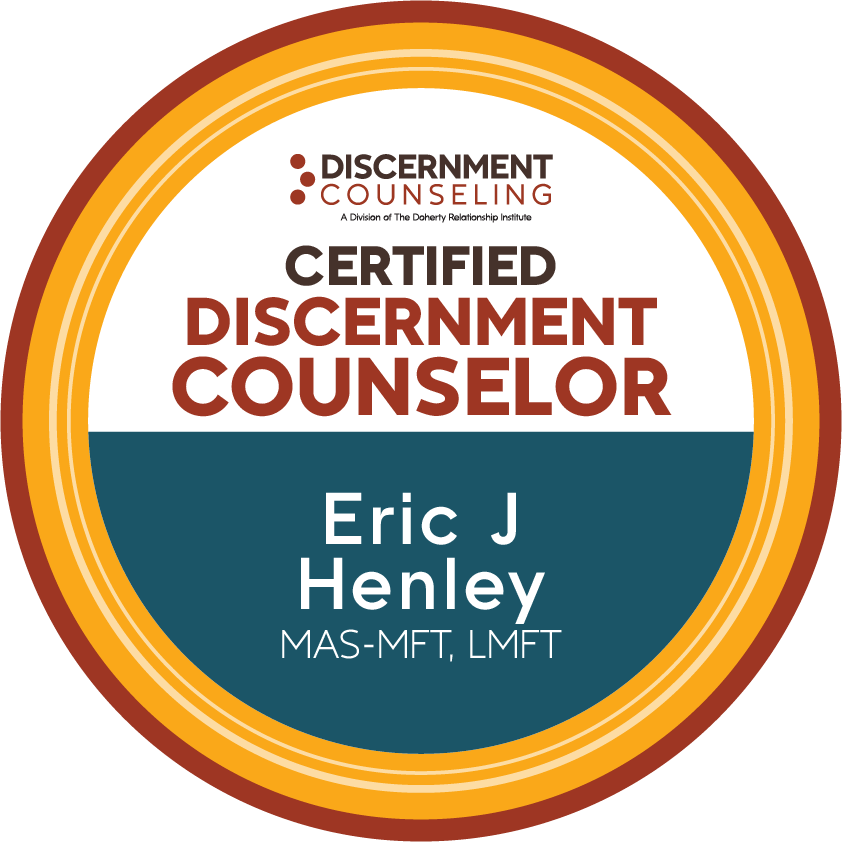
Eric J. Henley is a Certified Discernment Counselor. This is specialized work for relationships in which partners are not in the same place about the future. The goal is not to persuade either person. It is to create a calm, direct setting where both people can tell the truth about what has changed, what they have tried, and what they are willing to do next.
That focus matters when the relationship has become emotionally crowded. A couple may be carrying years of resentment, a recent betrayal, repeated promises that did not last, or the slow realization that the life they built together no longer feels connected. Those experiences deserve more than a quick vote on whether to stay or go. They need enough care and structure for each person to understand their own part without minimizing what hurts.
What this is and is not
Not a push to save the relationship at any cost.
Discernment counseling is not ordinary couples therapy with a different name. Couples therapy is often the right fit when both partners have already decided they want to work on the relationship and are prepared to practice new ways of relating. In that setting, the work can focus on rebuilding closeness, communicating differently, and making changes that hold up after a difficult session.
Discernment counseling is for the earlier question: is there enough shared willingness to begin that repair work? It can be useful when one person is leaning out, when divorce or separation has been discussed, or when both partners feel torn between hope and resignation. The process helps each person understand the relationship's story, the role they have played in its distress, and the choices ahead. It does not decide for you.
If you both decide that you are ready to rebuild, couples therapy can offer a more direct repair process. If betrayal is central to the uncertainty, affair recovery can help you face the injury, rebuild trust where possible, and understand what accountability needs to look like. If either partner is experiencing fear, intimidation, coercion, or violence, shared counseling is not the right first step. Safety and individual support need to come first.
Before the first conversation
You do not need a final answer to begin.
It can help to arrive with a few honest observations, not a polished explanation or a list of everything your partner has done wrong. Consider what you have already tried to change, what still feels unresolved, and what makes you most afraid about the future. You might notice that you are grieving a relationship you once had, questioning whether trust can return, or feeling exhausted by the work of carrying hope alone.
Try to make room for your own part in the pattern as well. That does not mean excusing betrayal, cruelty, or choices that caused real harm. It means asking what you do when you feel hurt, lonely, rejected, or afraid. Some people pursue harder. Some withdraw, stay quiet, overwork, or look outside the relationship for relief. Understanding those habits can make the next step clearer because it shifts the question from who is to blame to what would actually need to change.
You also do not have to decide whether to stay before asking for support. The first conversation can simply be a chance to describe where you are, ask whether discernment counseling fits your situation, and decide whether working together feels right. A steady setting can help you move out of the exhausting cycle of pressure, reassurance, and panic, so that whatever choice you make is more grounded in reality and care.
Frequently asked questions
01Who is discernment counseling for?+
Discernment counseling is for couples when one or both partners are uncertain about staying in the relationship. It is especially useful when one person is leaning toward leaving while the other hopes to repair the relationship.
02How is it different from couples therapy?+
Couples therapy usually begins with a shared decision to work on the relationship. Discernment counseling begins earlier, when that shared decision has not been made. It gives both people room to understand the relationship and decide what an honest next step requires.
03Can we meet online from Scottsdale?+
Yes. REtherapy Center offers online sessions throughout Arizona, including Scottsdale. Online counseling can provide a private, focused setting without adding a drive to an already difficult season.
04What if an affair or hidden relationship is part of the uncertainty?+
Discernment counseling can help couples face the uncertainty that follows betrayal, secrecy, or a serious breach of trust. If both partners decide they are ready to repair, affair recovery or couples therapy may become the more focused next step.
05Is discernment counseling appropriate when there is abuse or fear?+
No shared counseling process should be used when someone is afraid to speak honestly, is being threatened, or is experiencing coercion or violence. Safety and individual support need to come first.
A steady place to start